


AI Business Systems: The Secret Sauce to Smarter Growth
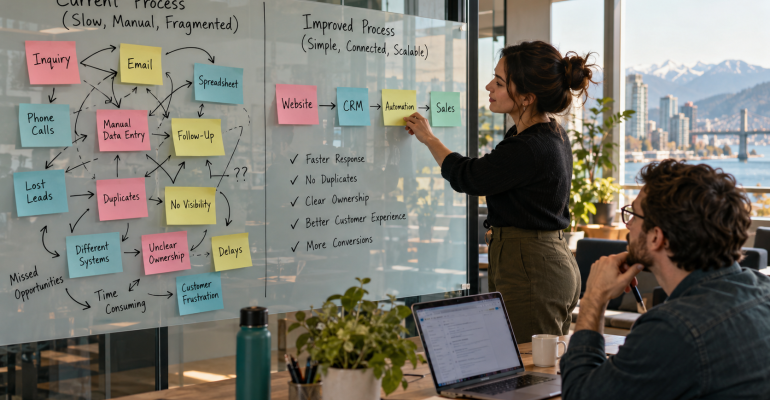
Your business gets a new website inquiry. Someone needs to check the message, enter the details into a spreadsheet, notify the sales team, and remember to follow up.
What happens when one of those steps gets missed?
For many growing businesses, the problem isn’t a lack of software. It’s that their tools don’t communicate.
AI business systems connect CRM software, search visibility, customer communication, and automation into workflows that reduce manual work and improve lead management.
Instead of adding more disconnected tools, businesses can create systems that support employees, customers, and daily operations.
What Are AI Business Systems?
AI business systems combine artificial intelligence, software integrations, and automated workflows to help businesses manage information and routine operations more efficiently.
A typical system may include:
- CRM software: Organizes contacts, leads, and sales opportunities.
- AI voice agents and chatbots: Handle routine inquiries and collect customer information.
- Workflow automation: Connects tasks, notifications, and follow-up activities.
- AI SEO: Helps potential customers discover relevant services online.
- Analytics: Tracks customer activity and business performance.
These technologies become more useful when they share information.
For example, a customer submitting a website form can automatically create a CRM record, receive a confirmation message, and trigger a task for a sales representative.
Not every process requires AI. Sometimes a simple automated rule is enough.
The objective is to connect technology around actual business needs rather than automate everything.
How Do AI SEO, CRM and Automation Work Together?
A connected business system links customer discovery with lead capture, follow-up, and sales.
Consider this journey:
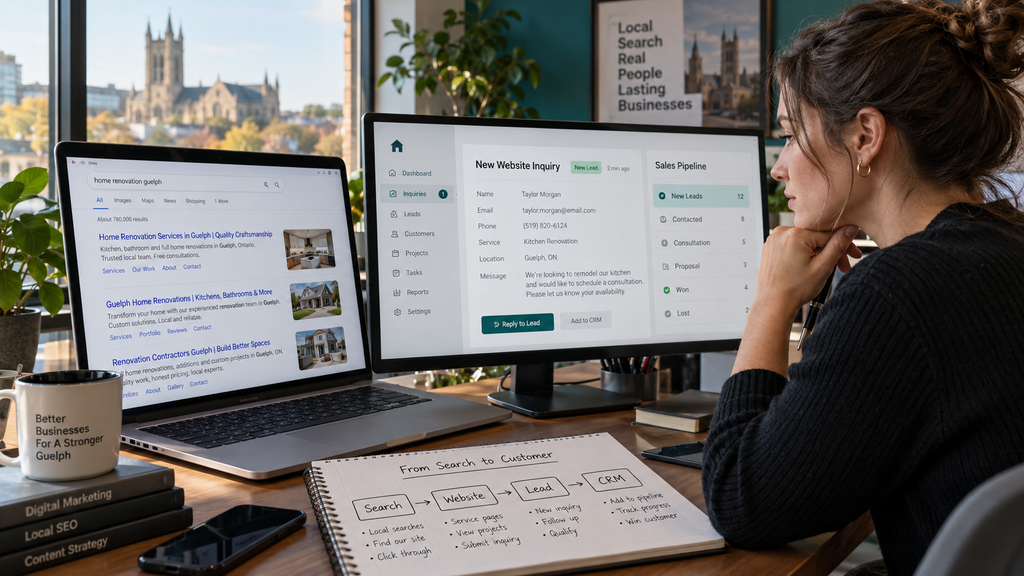
Search → Website → Lead Form → CRM → Automation → Sales
Each stage plays an important role.
AI SEO Brings Potential Customers to Your Website
Search visibility helps businesses appear when customers look for relevant services through Google, local search, or AI-assisted discovery.
According to Google’s SEO Starter Guide, search optimization helps search engines understand website content and users find relevant information.
However, generating traffic is only the beginning.
A business also needs a website that encourages relevant inquiries and a process for handling those inquiries.
INNO’s AI SEO and Search Visibility services connect search strategy with measurable business objectives.
CRM Turns Inquiries Into Organized Opportunities
Once someone submits a form or requests an appointment, the information should reach the appropriate team.
A connected CRM can record the inquiry, identify the requested service, assign responsibility, and track progress.
This reduces the risk of customer information becoming scattered across inboxes and spreadsheets.
Through CRM Software Solutions, businesses can explore lead management, sales pipelines, and integrations that connect customer interactions.
Automation Keeps the Process Moving
Automation can trigger confirmation messages, appointment reminders, internal notifications, and follow-up tasks.
AI chatbots or voice agents may also help collect routine inquiries and route them to employees.
The value comes from integration: information gathered through one channel becomes available to the next stage without repeated manual entry.
Which Business Processes Should You Automate First?
The best place to start is the process creating the most friction.
Before buying new software, ask where employees lose time, where customers experience delays, and where information gets lost.
| Business problem | Possible solution |
|---|---|
| Missed customer inquiries | AI voice intake or lead notifications |
| Manual contact entry | Website-to-CRM integration |
| Forgotten follow-ups | Automated reminders and tasks |
| Repetitive customer questions | AI chatbot with human escalation |
| Unclear sales progress | Connected CRM pipeline |
For example, a company missing after-hours phone inquiries might benefit more from an AI voice agent than from another marketing platform.
A business already receiving plenty of leads but struggling to follow up may need CRM automation instead.
INNO’s AI Automation, Chatbots and Workflows services focus on connecting routine tasks, communication, and business processes.
The right solution depends on the bottleneck—not the popularity of the technology.
What Does a Connected AI Business System Look Like?
Imagine a home-services company in Guelph, Ontario, receiving inquiries through Google Search, its website, and telephone calls.
Employees currently use emails and spreadsheets to organize appointments and estimates.
A connected workflow could work like this:
- Discovery: A homeowner finds the company through local search.
- Inquiry: The visitor completes a website form requesting an estimate.
- CRM: The system creates or updates the customer’s contact record.
- Automation: The customer receives a confirmation, and an employee gets a follow-up task.
- Scheduling: The employee reviews the request and arranges an appointment.
- Reporting: The business tracks the inquiry’s source, status, and outcome.
This hypothetical example demonstrates how connected tools can help employees manage customers without repeatedly transferring information between platforms.
The system doesn’t replace human judgment. It gives employees a more organized process to work with.
How Can You Measure the Value of AI Automation?
Automating more tasks doesn’t automatically mean a business is performing better.
The value should be measured through specific outcomes, such as:
- Response time: Are customers receiving faster responses?
- Administrative time: Are employees spending fewer hours on repetitive tasks?
- Lead conversion: Are more qualified inquiries becoming customers?
- Workflow accuracy: Are duplicate entries and missed follow-ups decreasing?
Suppose an employee spends six hours weekly entering customer information and coordinating notifications.
If a connected workflow reduces that to two hours, the business saves four hours of staff capacity each week.
At an illustrative labor cost of $30 per hour, that represents $120 in weekly capacity, before accounting for software, setup, and maintenance expenses.
The financial benefit depends on how the saved time is used and the total cost of operating the system.
What Should Businesses Avoid When Implementing AI Systems?
Poorly designed automation can create new problems instead of solving existing ones.
Businesses should avoid:
- Automating too many processes at once: Start with one measurable improvement.
- Ignoring data quality: Duplicate or incomplete CRM records can cause incorrect actions.
- Removing human oversight: Complex or sensitive customer inquiries need an appropriate escalation process.
- Overlooking privacy: Customer information needs suitable access controls, consent practices, and protection.
For Canadian businesses, the Office of the Privacy Commissioner’s Privacy Guide for Businesses provides guidance on handling personal information under PIPEDA, where applicable.
Businesses using automated marketing messages should also consider applicable consent and unsubscribe requirements.
A reliable AI business system needs clear processes, responsible data handling, and regular monitoring.
Build Smarter Business Systems With INNO Digital Solutions
Businesses don’t need to replace every existing platform or automate everything immediately.
A more practical approach is to identify one high-value problem, connect the relevant tools, and expand when the workflow produces useful results.
INNO Digital Solutions’ AI & Business Systems approach brings together search visibility, CRM, AI communication, automation, and connected digital workflows.
For businesses in Guelph and beyond, these capabilities can help improve how customer information moves from the first inquiry to the final sales outcome.
Ready to connect your business tools?
Contact INNO Digital Solutions to discuss your current workflow challenges and explore practical opportunities for AI, CRM, and business automation.
Frequently Asked Questions
What is an AI business system?
An AI business system connects technologies such as CRM software, AI communication tools, automation, and digital platforms into coordinated workflows that support customer management and business operations.
Can AI business systems work with existing software?
Yes. Many CRM, marketing, scheduling, and communication platforms support integrations through APIs or built-in connectors. Compatibility depends on the existing applications and their technical capabilities.
Are AI business systems suitable for small businesses?
Yes, when a specific operational problem justifies the cost. Small businesses can begin with website lead capture, CRM integration, or automated reminders before adding more advanced capabilities.
How do I know what to automate first?
Identify repetitive tasks, missed inquiries, customer delays, or processes that regularly require manual data entry. Prioritize one workflow, measure its current performance, and evaluate the improvement before expanding.