



Powerful Reasons Guelph Businesses Need AI Voice Agent
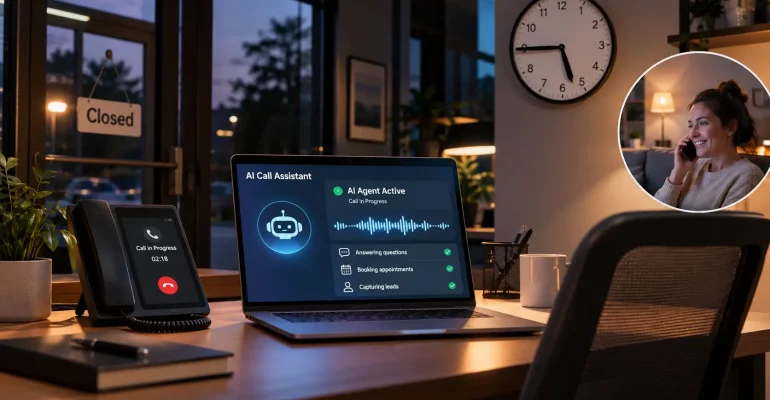
It’s 6:17 p.m. A potential customer calls a Guelph business to book a service for tomorrow. The office closes at five, so the phone rings until voicemail takes over. Without an AI voice agent, the caller hangs up without leaving a message.
When abandoned calls become missed opportunities, perhaps it’s time for an AI voice agent to assist your after-hours enquiries, turning these missed calls into successful bookings.
AI voice agents help Guelph businesses by offering an efficient experience: the customer can answer a routine question, collect contact details, or request an appointment. Still, a useful phone system needs more than a convincing voice. It needs reliable information, appropriate safeguards, and a clear route to a person when the conversation becomes complicated.
What Happens to Calls After Business Hours?
A missed call is not automatically a lost sale. Some people leave messages or call back. Others contact another provider. Without tracking incoming calls and outcomes, businesses cannot know which situation is happening most often.
Consider a hypothetical home-service company that receives six calls after working hours each week. If half are genuine service enquiries, that is three conversations worth investigating, not three guaranteed customers.
The first task is to understand those calls, not assume automation will turn every one into revenue. It’s important to check missed call times, repeat callers, voicemail rates, callback delays, and eventual bookings.
What Can AI Voice Agents Actually Do?
An AI voice agent is basically a software that interacts with a caller using spoken language. Depending on its integrations and configuration, it may identify the reason for a call, answer approved questions, record an enquiry, or trigger a follow-up task.
For example, a Guelph customer might ask whether a service business works in the south end of the city. The agent could give an answer drawn from the company’s approved service-area information, then request a callback number if the customer wants a quote.
Common uses of AI voice agents include:
- After-hours enquiry intake: Gathering the caller’s name, contact details, and reason for calling.
- Routine questions: Explaining confirmed hours, locations, service areas, or booking policies.
- Appointment requests: Checking available times when a reliable scheduling integration exists.
- Human handoffs: Transferring urgent or complex calls when staff are available, or flag them for priority follow-up.
These capabilities are not universal. A voice agent without calendar access shouldn’t promise a confirmed appointment. Moreso, one without accurate service data shouldn’t invent an answer.
Where Can AI Call Answering Go Wrong?
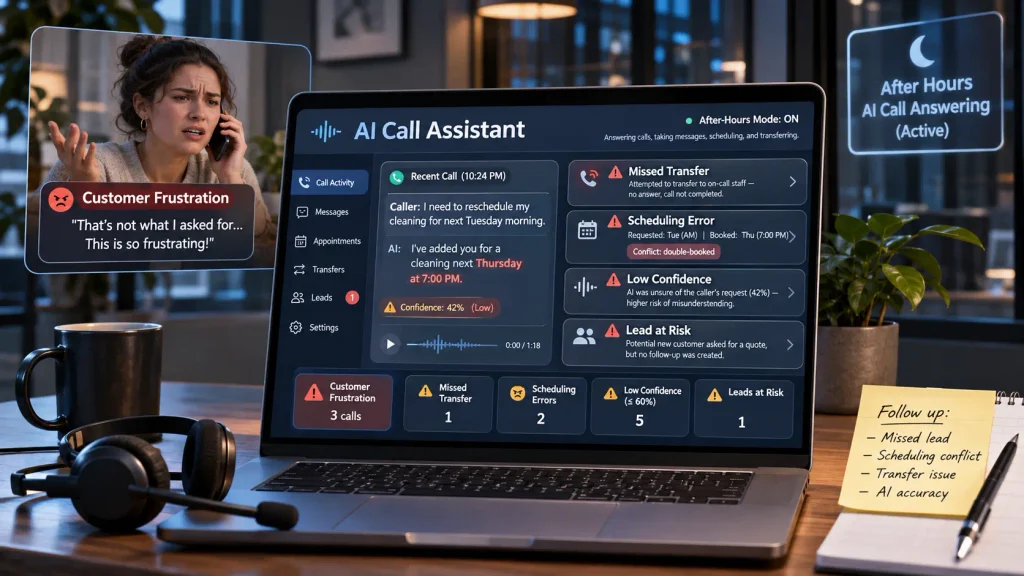
A fluent answer can still be wrong. An agent might misunderstand a street name, confuse a requested service with a different one, or miss a caller’s frustration.
The risk increases when the conversation involves emergencies, disputes, sensitive personal information, unusual requests, or decisions that require professional judgment. Those scenarios need defined limits and a human escalation process.
A safe design should make it clear that the caller is interacting with AI. It should also explain what information is collected, avoid unnecessary details, and confirm important information rather than guessing.
For instance, a system should say, “I can send your appointment request to the team,” if it cannot verify a booking. That is more useful than confidently telling someone that their time is reserved, even when no calendar entry exists.
AI Receptionist, Voicemail, or Human Answering Service?
There is no single best option for every business. The right choice depends on call volume, complexity, budget, staffing, and how quickly callers need a decision.
| Option | Potential advantage | Main limitation |
| Voicemail | Simple way to collect messages | Some callers leave without recording one |
| Human answering service | People can handle nuance and unexpected questions | Availability, pricing, and training vary |
| AI voice agent | Can handle defined routine conversations outside office hours | Requires testing, integrations, and escalation safeguards |
| In-house receptionist | Familiar with company operations and customers | Coverage ends when staff are unavailable |
Businesses can also combine approaches. For instance, an AI agent might handle straightforward after-hours intake, while employees make decisions, return complex calls, and manage sensitive situations.
How Should a Guelph Business Test an AI Voice Agent?
It’s essential to start with one tightly defined job rather than handing over every incoming call to an AI voice agent.
Step 1: Choose a low-risk call type. Select enquiries about hours, service availability, or requests for a callback.
Step 2: Build an approved answer library. Use accurate service descriptions, business hours, locations, and policies. Assign a person to keep this information updated.
Step 3: Create a clear handoff rule. Define when callers reach a person, receive a callback commitment, or get an alternative emergency instruction.
Step 4: Test realistic conversations. Try local street names, background noise, corrections, interruptions, and callers who change their minds midway through.
Step 5: Review outcomes. Measure captured enquiries, successful transfers, booking errors, customer complaints, and cases requiring manual correction.
You can run a limited pilot before expanding the system. Simply answering more calls is not the objective here. Rather, it is to handle them accurately and make the next step easier for the caller.
What About Call Recording and Privacy in Ontario?
Of course, customer voice data deserves particular care.
Canada’s Office of the Privacy Commissioner updated its guidance on recording customer calls in October 2026, including additional considerations involving sensitive voice print information.
Its guidance explains that organizations subject to PIPEDA must handle recordings appropriately, and this includes informing customers about recording purposes and consent. Even with outsourced call handling, the organization has full accountability on how it manages customer information.
Before launching an agent, establish whether calls are recorded or transcribed, what data is retained, who can access it, and when it is deleted. Avoid collecting sensitive information unless genuinely necessary. Privacy and consent requirements should be reviewed for the specific business and implementation.
When Is an AI Voice Agent Necessary for Your Business?
An AI voice agent may be worth exploring when a business clearly requires assistance with after-hours and overflow call handling. This includes regular routine queries outside office hours, predictable peaks, or a better way to capture enquiry details.
It may be a poor fit when most conversations require human empathy and complex decision-making skills. These scenarios often rely on a person’s expert judgment, maintenance of accurate information, and a reliable way for callers to reach a human when needed.
Frequently Asked Questions (FAQs)
Can an AI voice agent book appointments automatically?
Potentially, if it has a dependable scheduling integration, appropriate permissions, and rules for confirming availability. Without those capabilities, it should collect an appointment request rather than guarantee a booking.
Will an AI receptionist replace my staff?
Not necessarily. Common uses for AI receptionists include handling routine calls and collecting information. Employees often manage exceptions, specialist advice, complaints, and customer relationships.
Can an AI voice agent answer calls outside business hours?
Yes, a suitably configured system can respond outside staffed hours. Its actual availability depends on the phone service, integrations, hosting reliability, and the business’s escalation plan.
How can I tell whether AI phone answering is worthwhile?
Compare the current volume and outcomes of missed calls with pilot results. Consider setup and operating costs, staff time, successful enquiries, booking accuracy, and customer feedback before deciding whether to use AI phone answering services.
Optimize Your Call Operations Strategy with INNO
INNO Digital Solutions’ AI voice agent services in Guelph offers a relevant starting point for businesses that are evaluating this approach. The right project begins by mapping actual call types, deciding what should be automated, and defining what must remain in human hands.
A phone that always talks is not the automatic solution. Instead, a phone experience that helps customers reach the next step, even at 6:17 p.m, is the real game changer.