



Get Found on Google Maps: Avoid These Business-Killing Mistakes
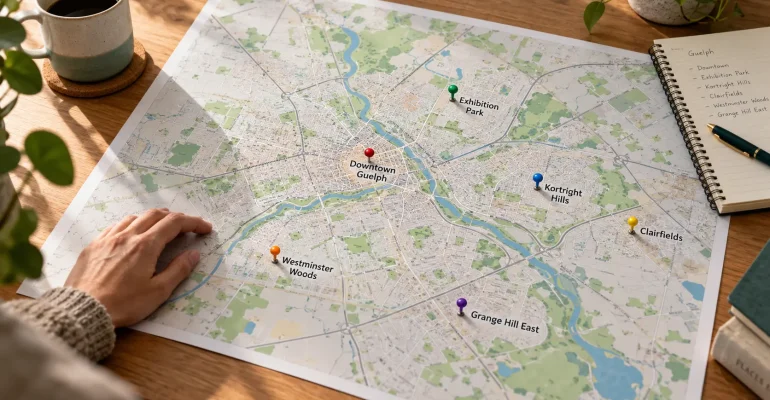
Google Maps ranking results can tell two very different stories about the same business. A company might appear near the top when someone searches from Downtown Guelph, yet become difficult to find when that same search happens near Westminster Woods or Clairfields.
For business owners, this inconsistency can be frustrating. A competitor offering similar services appears prominently, while their own listing seems to disappear. The business hasn’t changed, so why has its visibility?The answer involves how Google evaluates local searches, and why your ranking at one location doesn’t necessarily reflect your visibility throughout the city.
One Business, Three Guelph Neighbourhoods
Imagine a fictional home-renovation company based near Downtown Guelph. The owner searches Google Maps for a renovation contractor and finds the business among the leading results.
Later, a prospective customer performs a similar search from Kortright Hills. Several other companies appear, while the original business is positioned much lower. Another customer searches from Grange Hill East and sees a different selection of businesses altogether.
Nothing about the company’s services or website has changed between these searches. What has changed is the search context, including the customer’s location and the competing businesses Google considers relevant.
This is why checking a Google Maps ranking from one device, neighborhood, or office location can create a misleading impression of how discoverable a business really is.
What Determines Who Appears on Google Maps Ranking?
Google identifies three primary factors influencing local search results: relevance, distance, and prominence. Understanding these factors helps explain why businesses can rank differently even when they offer similar services.
Relevance: Does Your Business Match the Search?
Relevance describes how closely a business matches what someone is searching for.
If someone searches for a website development company, Google Maps Ranking needs enough accurate information to understand which businesses offer that service. Appropriate business categories, complete profile information, and clear service descriptions help communicate what a company actually does.
A business that describes itself only in broad terms may be less helpful to someone looking for a specific service.
Distance: Where Is the Customer Searching?
Distance considers how far a business is from the location associated with the search. This explains why results may vary between Downtown Guelph, Exhibition Park, Riverside Park, Kortright Hills, and Clairfields. A business near one neighborhood isn’t equally close to customers throughout the city.
No optimization tool can change a company’s genuine physical location. Creating misleading business addresses to influence rankings is not an appropriate solution.
Prominence: How Established Is the Business?
Prominence relates to how well-known a business is, based partly on information available across the web.
Google identifies factors such as reviews, ratings, and links when discussing local prominence. Businesses can improve the quality of their public presence through accurate information, legitimate customer feedback, and relevant online references.
Google explains these factors in its official guide to improving local rankings.
The important distinction is that rankings involve several signals working together. No provider can guarantee first place in Google Maps by simply adding more keywords or by purchasing a particular SEO package.
What a Local Ranking Heatmap Can Reveal
A conventional ranking report might indicate that a business appears in position five for a particular keyword. That sounds useful, but it leaves out an important question: position five from where?
Local ranking heatmaps examine a search term from multiple geographic points. Rather than displaying one position, they create a visual pattern showing where a business appears consistently and where visibility becomes weaker.
For a Guelph business, a scan could include neighbourhoods such as Downtown, Exhibition Park, The Ward, Old University, Riverside Park, Grange Hill East, Kortright Hills, Clairfields, and Westminster Woods.
A hypothetical report might reveal:
| Search area | Example ranking | What it suggests |
| Downtown Guelph | 3 | Stronger visibility near the business |
| Exhibition Park | 6 | Moderate local visibility |
| Kortright Hills | 12 | More competition or weaker proximity |
| Clairfields | Outside top 20 | Limited visibility in the tracked range |
| Grange Hill East | 15 | Opportunity to investigate local relevance |
These figures are illustrative, not actual rankings for a Guelph business.
A heatmap doesn’t tell a business exactly how many customers it receives. It also cannot isolate the influence of each Google ranking factor.
Rather, its value lies in showing geographic patterns that a single search result could miss.
What Should a Guelph Business Improve First?
Before making sweeping website changes, businesses should examine whether their existing information accurately represents their services, location, and customer experience. A practical review begins with the Google Business Profile. Confirm that the business name, primary category, address or appropriate service area, opening hours, and contact details are accurate.
Next, examine the website. Can potential customers quickly determine what services are offered? Are important service pages easy to find? Does the business explain which communities it genuinely serves?
A focused review should consider:
- Business information: Accurate, complete details across relevant platforms.
- Service relevance: Appropriate categories and clear descriptions of actual services.
- Website content: Useful pages addressing customer questions and service needs.
- Reputation: Genuine customer reviews and appropriate responses.
- Technical accessibility: Pages that search engines can crawl and understand.
- Geographic visibility: Consistent heatmap testing over time.
For example, a Guelph business serving customers across the city could clearly describe its services and genuine coverage without publishing dozens of nearly identical neighborhood pages.
The objective is to strengthen the information available to customers, not manipulate the appearance of local relevance.
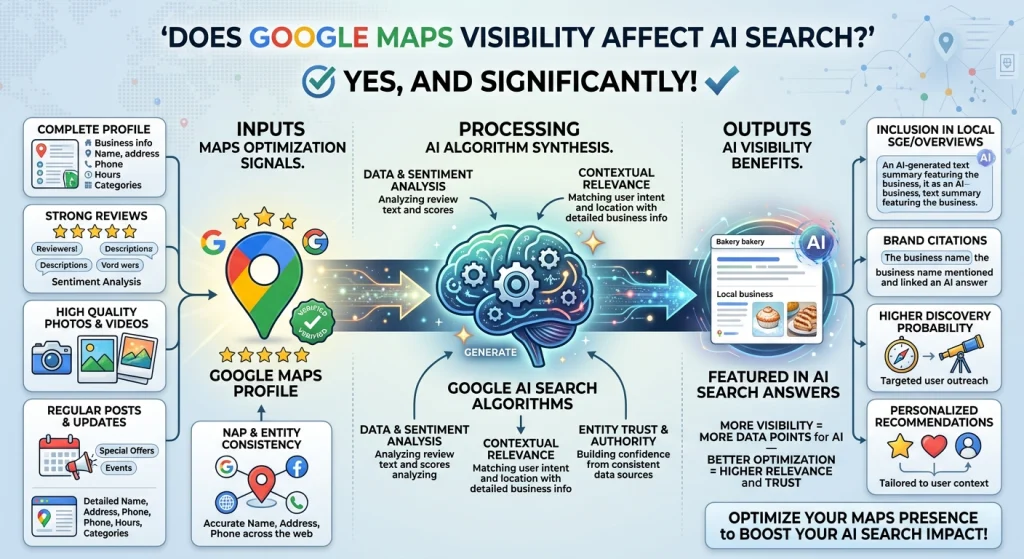
Does Google Maps Ranking Visibility Affect AI Search?
Google Maps Ranking and AI-assisted search are connected to the broader online discovery experience, but they shouldn’t be treated as identical ranking systems.
A customer might use Google Maps to find a nearby business and then ask an AI assistant to compare providers or explain which services best fit their requirements. Another customer might begin with a conversational question such as, “Which companies provide local SEO and website development for small businesses in Guelph?“
These questions involve different information needs. One emphasizes geographic discovery, while the other may require detailed explanations, comparisons, and supporting sources.
Google’s guidance on AI features and websites explains that foundational SEO practices remain important for AI Overviews and AI Mode, including accessible content, useful information, and accurate business details.
However, strong Google Maps visibility does not guarantee inclusion in AI-generated recommendations. This is where a wider search strategy becomes relevant. INNO Digital Solutions’ AI SEO and search visibility in Guelph approach covers local discovery, technical SEO, content research, and emerging AI search experiences.
Being Found Isn’t the Same as Being Chosen
Return to the fictional renovation company from the beginning of this article.
Its visibility might be strong near Downtown Guelph but weaker across other neighbourhoods. Improving business information, website relevance, and local credibility may help strengthen its overall discoverability, although specific ranking improvements cannot be guaranteed.
Yet appearing in a Maps result is only one part of the customer’s decision.
A visitor may still compare project examples, reviews, service descriptions, and contact options before choosing a provider. The website and business listing need to support that next stage with useful, consistent information.
For Guelph companies, a better question than “Are we ranking?” is:
“Where can customers find us, where are we being overlooked, and what happens when they discover our business?” Understanding those differences is a practical starting point for improving local search visibility.